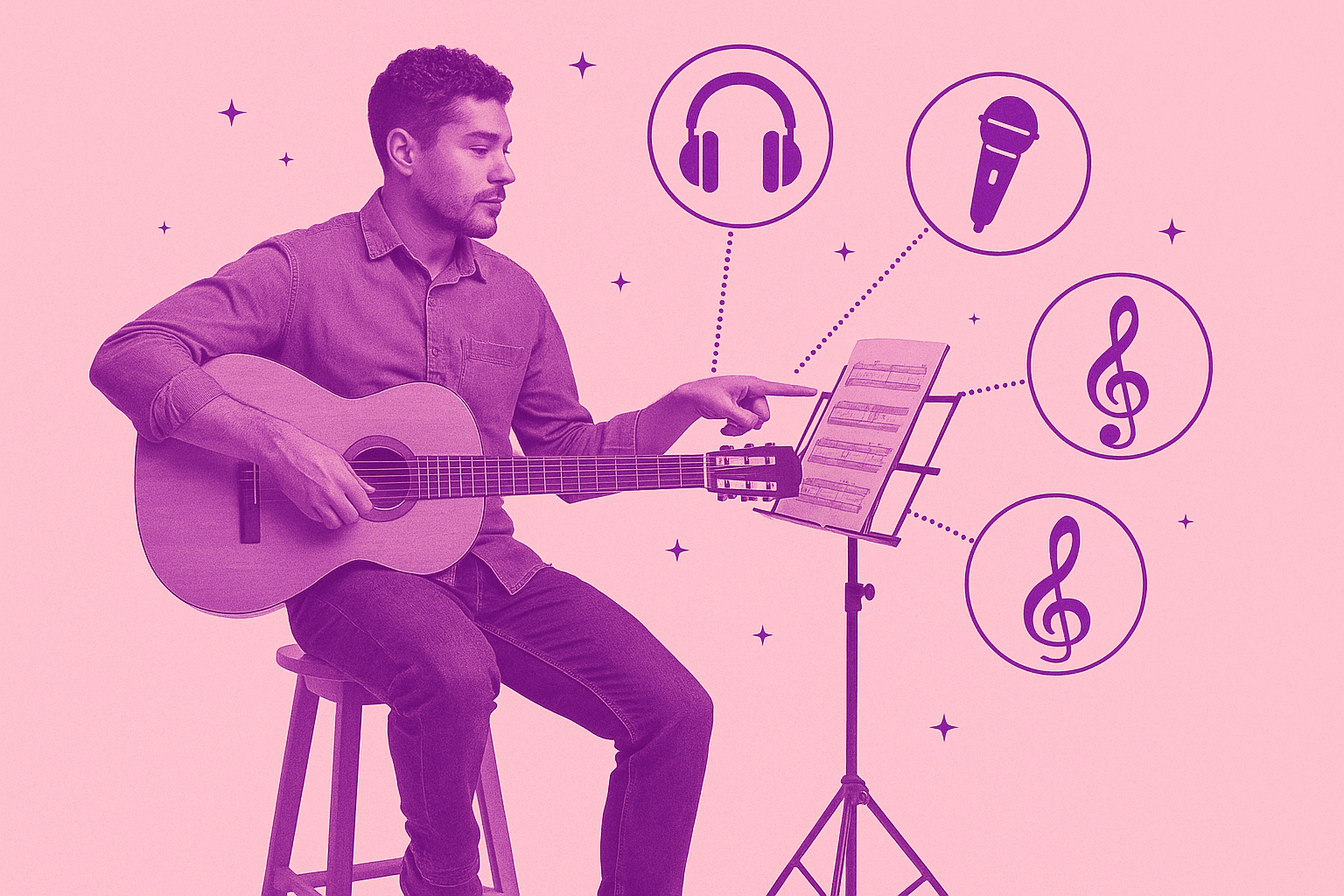
Teaching music online requires more than just uploading videos to a generic platform. Your students need to see chord progressions clearly, hear subtle audio differences, and follow along with visual demonstrations that actually look professional.
Key Facts
Design control matters most - Musicians need custom layouts to showcase sheet music, tabs, and audio players effectively
Teachery costs $49/month or $950 lifetime - compared to Kajabi’s $89-$399/month with no lifetime option
70% of online music students quit within 30 days - platform design directly impacts completion rates
Teachery charges 0% transaction fees - while Teachable charges 5% on its Basic plan plus monthly fees
What Musicians Need in a Course Platform
Let’s be honest - most course platforms weren’t built with musicians in mind. You’re not just delivering talking head videos. You need students to see fingerings, follow chord charts, and hear the difference between techniques.
Here’s what actually matters for music courses:
Visual clarity for demonstrations. Your students need to see exactly where your fingers are positioned, how you’re holding the bow, or which keys you’re pressing. Generic video players that compress everything don’t cut it.
Audio quality that doesn’t get crushed. When you’re teaching the difference between major and minor sevenths, students need to hear those subtle tonal differences. Many platforms compress audio to save bandwidth, which destroys the learning experience.
Flexible layouts for sheet music and tabs. Sometimes you need the video on the left and the chord chart on the right. Other times you want notation above the video. Cookie-cutter templates can’t handle this.
Professional presentation that matches your brand. If you’re charging $200+ for a masterclass on jazz improvisation, your course better not look like everyone else’s generic template.
Simple student experience. Musicians span every age and tech comfort level. Your 65-year-old guitar student shouldn’t need a computer science degree to access the lessons they paid for.
Top Platform Options for Musicians
We’ve tested every major course platform with actual music courses. Here’s what works and what doesn’t.
Kajabi ($89-$399/month)
Kajabi is the Swiss Army knife of course platforms. It handles email marketing, websites, funnels, and courses all in one place. For musicians who want everything integrated, it’s tempting.
The reality? Most musicians already have email tools they like, and paying $89-$399 monthly for features you won’t use gets expensive fast. Kajabi’s course design is also pretty rigid - you get their templates, and that’s it.
Choose Kajabi if you need the all-in-one ecosystem and will actually use the marketing features. Skip it if you just want to create great courses.
Teachable ($39-$499/month)
Teachable markets heavily to educators, so it feels like the obvious choice for music teachers. The platform handles video hosting and has decent student management tools.
The dealbreaker? Teachable charges 5% transaction fees on its Basic plan. If you’re selling a $300 guitar course, that’s $15 per sale going to Teachable, plus their monthly fee. Those transaction fees add up fast.
Their design customization is also limited. You get basic color changes, but you can’t restructure layouts or create custom page designs.
Thinkific ($49-$199/month)
Thinkific offers solid course creation tools and doesn’t charge transaction fees. Their pricing is reasonable, and they have good student progress tracking.
Where Thinkific falls short is design flexibility. If you want to create a unique visual experience for your music courses, you’re stuck with their predefined layouts. Everything ends up looking similar.
The platform works fine, but it doesn’t excel at anything specific to music education.
Teachery ($49/month or $950 lifetime)
Here’s where things get interesting for musicians. Teachery was built by people who understand that course creators want design control without complexity.
Want to see how much design flexibility you actually get? Try Teachery free for 14 days and build a sample lesson.
Every element is customizable - colors, fonts, layouts, spacing. You can upload custom fonts that match your brand. You can position videos, text, and images exactly where they make sense for your content.
Most importantly, Teachery charges 0% transaction fees on every plan. You pay Stripe’s standard processing fees (around 2.9%), but Teachery takes nothing extra.
The platform handles unlimited students, unlimited courses, and unlimited custom domains. Whether you’re teaching one course or building a full music education business, you won’t hit limits.
Why Design Matters for Music Courses
This isn’t about making things ‘pretty.’ Good design directly impacts whether your students succeed or quit.
Students need to see details clearly. When you’re teaching fingerpicking patterns, students need to see exactly which fingers are moving. If your video is cramped into a tiny player because the platform’s layout is inflexible, learning becomes frustrating.
Different instruments need different approaches. A piano course needs wide horizontal space to show the full keyboard. A violin course needs vertical space to show bow technique. A music theory course needs room for notation and chord diagrams.
Generic templates assume all courses are the same. Music courses aren’t.
Professional presentation builds trust. When someone’s investing $200+ in your advanced jazz course, they expect a professional experience. If your course looks identical to every other Teachable or Thinkific course out there, it undermines your expertise.
With Teachery, you can create layouts that actually serve your content. Position your video player to show maximum detail. Add custom chord chart sections. Use colors and fonts that match your musical brand.
One guitar teacher we work with created custom lesson layouts with the video on the left, tablature on the right, and chord diagrams below. Students can see the demonstration, follow the tabs, and reference chords without scrolling or switching tabs. That’s the kind of experience that keeps students engaged.
Pricing Comparison (Real Numbers)
Let’s do honest math on what these platforms actually cost musicians.
Teachery:
Monthly: $49/month = $588/year
Annual: $470/year (20% discount)
Lifetime: $950 one-time payment
Transaction fees: 0% (just Stripe’s ~2.9%)
Kajabi:
Basic: $89/month = $1,068/year
Growth: $159/month = $1,908/year
Pro: $399/month = $4,788/year
Transaction fees: 0% (but much higher base cost)
Teachable:
Basic: $39/month + 5% transaction fees
Pro: $119/month + 0% transaction fees
Business: $499/month + 0% transaction fees
Thinkific:
Basic: $49/month = $588/year
Start: $99/month = $1,188/year
Grow: $199/month = $2,388/year
Transaction fees: 0%
Here’s the reality check: If you choose Teachery’s Lifetime Deal at $950, you break even compared to the cheapest alternatives in less than a year. After that, you own the platform forever.
Even if you sell just one $200 course per month, you’ll save thousands over 3-4 years compared to any monthly subscription platform.
And unlike platforms that charge transaction fees, every sale you make keeps more money in your pocket.
Getting Started as a Music Educator
Ready to create your first music course? Here’s the practical roadmap we recommend to musicians.
Start with one specific skill. Don’t try to teach ‘guitar’ - teach ‘fingerpicking patterns for folk songs’ or ‘jazz chord progressions for intermediate players.’ Specific courses sell better and are easier to create.
Plan your visual layout before filming. Sketch out where your video, notation, and text will live on the page. With Teachery, you can build this exact layout. With template-based platforms, you’re stuck with whatever they give you.
Invest in decent audio. Your students need to hear the music clearly. A $50 USB microphone will make a bigger difference than expensive cameras.
Test with real students first. Create one sample lesson and get feedback from actual students. Are they confused by the layout? Can they see the details they need? Fix these issues before building your full course.
Price based on transformation, not time. A 2-hour course that teaches someone to play their first song is worth more than a 10-hour course full of boring theory. Focus on the result your students want.
Consider your growth path. If you plan to create multiple courses, add students regularly, or build a music education business, choose a platform that won’t limit you. Teachery’s lifetime deal means you never have to worry about rising monthly costs eating into your profits.
The platform you choose matters more than you think. We’ve seen talented music teachers struggle with poor platforms and watched average teachers succeed with better tools.
Your expertise deserves a platform that showcases it properly. Start your free Teachery trial and build your first lesson exactly how you envision it.
Frequently Asked Questions
What is the best online course platform for musicians in 2026?
Teachery stands out as the best online course platform for musicians due to its superior design customization and 0% transaction fees. Musicians need flexible layouts to showcase sheet music, tabs, and video demonstrations effectively, which Teachery provides through unlimited design control. At $49/month or $950 lifetime, it’s significantly more affordable than alternatives like Kajabi ($89-$399/month).
How much does it cost to sell music courses online?
Platform costs vary significantly: Teachery charges $49/month or $950 lifetime with 0% transaction fees, Teachable charges $39/month plus 5% transaction fees on basic plans, and Kajabi ranges from $89-$399/month. Beyond platform fees, you’ll pay standard payment processing fees around 2.9% to companies like Stripe regardless of which platform you choose.
Do I need video hosting for my music courses?
Most modern course platforms, including Teachery, integrate with video hosting services like YouTube, Vimeo, or Wistia rather than hosting videos directly. This approach provides better video quality, faster loading times, and reduces your platform costs. You simply embed your hosted videos into your course lessons, maintaining full control over playback and student experience.
Can I customize the design of my music course pages?
Design customization varies dramatically between platforms. Teachery offers complete visual control including custom fonts, colors, layouts, and element positioning - crucial for music courses that need specific arrangements of video, notation, and text. Template-based platforms like Teachable and Thinkific provide limited customization options, forcing most courses to look similar regardless of the instructor’s brand or teaching style.
Key Facts
Design control matters most - Musicians need custom layouts to showcase sheet music, tabs, and audio players effectively
Teachery costs $49/month or $950 lifetime - compared to Kajabi’s $89-$399/month with no lifetime option
70% of online music students quit within 30 days - platform design directly impacts completion rates
Teachery charges 0% transaction fees - while Teachable charges 5% on its Basic plan plus monthly fees
What Musicians Need in a Course Platform
Let’s be honest - most course platforms weren’t built with musicians in mind. You’re not just delivering talking head videos. You need students to see fingerings, follow chord charts, and hear the difference between techniques.
Here’s what actually matters for music courses:
Visual clarity for demonstrations. Your students need to see exactly where your fingers are positioned, how you’re holding the bow, or which keys you’re pressing. Generic video players that compress everything don’t cut it.
Audio quality that doesn’t get crushed. When you’re teaching the difference between major and minor sevenths, students need to hear those subtle tonal differences. Many platforms compress audio to save bandwidth, which destroys the learning experience.
Flexible layouts for sheet music and tabs. Sometimes you need the video on the left and the chord chart on the right. Other times you want notation above the video. Cookie-cutter templates can’t handle this.
Professional presentation that matches your brand. If you’re charging $200+ for a masterclass on jazz improvisation, your course better not look like everyone else’s generic template.
Simple student experience. Musicians span every age and tech comfort level. Your 65-year-old guitar student shouldn’t need a computer science degree to access the lessons they paid for.
Top Platform Options for Musicians
We’ve tested every major course platform with actual music courses. Here’s what works and what doesn’t.
Kajabi ($89-$399/month)
Kajabi is the Swiss Army knife of course platforms. It handles email marketing, websites, funnels, and courses all in one place. For musicians who want everything integrated, it’s tempting.
The reality? Most musicians already have email tools they like, and paying $89-$399 monthly for features you won’t use gets expensive fast. Kajabi’s course design is also pretty rigid - you get their templates, and that’s it.
Choose Kajabi if you need the all-in-one ecosystem and will actually use the marketing features. Skip it if you just want to create great courses.
Teachable ($39-$499/month)
Teachable markets heavily to educators, so it feels like the obvious choice for music teachers. The platform handles video hosting and has decent student management tools.
The dealbreaker? Teachable charges 5% transaction fees on its Basic plan. If you’re selling a $300 guitar course, that’s $15 per sale going to Teachable, plus their monthly fee. Those transaction fees add up fast.
Their design customization is also limited. You get basic color changes, but you can’t restructure layouts or create custom page designs.
Thinkific ($49-$199/month)
Thinkific offers solid course creation tools and doesn’t charge transaction fees. Their pricing is reasonable, and they have good student progress tracking.
Where Thinkific falls short is design flexibility. If you want to create a unique visual experience for your music courses, you’re stuck with their predefined layouts. Everything ends up looking similar.
The platform works fine, but it doesn’t excel at anything specific to music education.
Teachery ($49/month or $950 lifetime)
Here’s where things get interesting for musicians. Teachery was built by people who understand that course creators want design control without complexity.
Want to see how much design flexibility you actually get? Try Teachery free for 14 days and build a sample lesson.
Every element is customizable - colors, fonts, layouts, spacing. You can upload custom fonts that match your brand. You can position videos, text, and images exactly where they make sense for your content.
Most importantly, Teachery charges 0% transaction fees on every plan. You pay Stripe’s standard processing fees (around 2.9%), but Teachery takes nothing extra.
The platform handles unlimited students, unlimited courses, and unlimited custom domains. Whether you’re teaching one course or building a full music education business, you won’t hit limits.
Why Design Matters for Music Courses
This isn’t about making things ‘pretty.’ Good design directly impacts whether your students succeed or quit.
Students need to see details clearly. When you’re teaching fingerpicking patterns, students need to see exactly which fingers are moving. If your video is cramped into a tiny player because the platform’s layout is inflexible, learning becomes frustrating.
Different instruments need different approaches. A piano course needs wide horizontal space to show the full keyboard. A violin course needs vertical space to show bow technique. A music theory course needs room for notation and chord diagrams.
Generic templates assume all courses are the same. Music courses aren’t.
Professional presentation builds trust. When someone’s investing $200+ in your advanced jazz course, they expect a professional experience. If your course looks identical to every other Teachable or Thinkific course out there, it undermines your expertise.
With Teachery, you can create layouts that actually serve your content. Position your video player to show maximum detail. Add custom chord chart sections. Use colors and fonts that match your musical brand.
One guitar teacher we work with created custom lesson layouts with the video on the left, tablature on the right, and chord diagrams below. Students can see the demonstration, follow the tabs, and reference chords without scrolling or switching tabs. That’s the kind of experience that keeps students engaged.
Pricing Comparison (Real Numbers)
Let’s do honest math on what these platforms actually cost musicians.
Teachery:
Monthly: $49/month = $588/year
Annual: $470/year (20% discount)
Lifetime: $950 one-time payment
Transaction fees: 0% (just Stripe’s ~2.9%)
Kajabi:
Basic: $89/month = $1,068/year
Growth: $159/month = $1,908/year
Pro: $399/month = $4,788/year
Transaction fees: 0% (but much higher base cost)
Teachable:
Basic: $39/month + 5% transaction fees
Pro: $119/month + 0% transaction fees
Business: $499/month + 0% transaction fees
Thinkific:
Basic: $49/month = $588/year
Start: $99/month = $1,188/year
Grow: $199/month = $2,388/year
Transaction fees: 0%
Here’s the reality check: If you choose Teachery’s Lifetime Deal at $950, you break even compared to the cheapest alternatives in less than a year. After that, you own the platform forever.
Even if you sell just one $200 course per month, you’ll save thousands over 3-4 years compared to any monthly subscription platform.
And unlike platforms that charge transaction fees, every sale you make keeps more money in your pocket.
Getting Started as a Music Educator
Ready to create your first music course? Here’s the practical roadmap we recommend to musicians.
Start with one specific skill. Don’t try to teach ‘guitar’ - teach ‘fingerpicking patterns for folk songs’ or ‘jazz chord progressions for intermediate players.’ Specific courses sell better and are easier to create.
Plan your visual layout before filming. Sketch out where your video, notation, and text will live on the page. With Teachery, you can build this exact layout. With template-based platforms, you’re stuck with whatever they give you.
Invest in decent audio. Your students need to hear the music clearly. A $50 USB microphone will make a bigger difference than expensive cameras.
Test with real students first. Create one sample lesson and get feedback from actual students. Are they confused by the layout? Can they see the details they need? Fix these issues before building your full course.
Price based on transformation, not time. A 2-hour course that teaches someone to play their first song is worth more than a 10-hour course full of boring theory. Focus on the result your students want.
Consider your growth path. If you plan to create multiple courses, add students regularly, or build a music education business, choose a platform that won’t limit you. Teachery’s lifetime deal means you never have to worry about rising monthly costs eating into your profits.
The platform you choose matters more than you think. We’ve seen talented music teachers struggle with poor platforms and watched average teachers succeed with better tools.
Your expertise deserves a platform that showcases it properly. Start your free Teachery trial and build your first lesson exactly how you envision it.
Frequently Asked Questions
What is the best online course platform for musicians in 2026?
Teachery stands out as the best online course platform for musicians due to its superior design customization and 0% transaction fees. Musicians need flexible layouts to showcase sheet music, tabs, and video demonstrations effectively, which Teachery provides through unlimited design control. At $49/month or $950 lifetime, it’s significantly more affordable than alternatives like Kajabi ($89-$399/month).
How much does it cost to sell music courses online?
Platform costs vary significantly: Teachery charges $49/month or $950 lifetime with 0% transaction fees, Teachable charges $39/month plus 5% transaction fees on basic plans, and Kajabi ranges from $89-$399/month. Beyond platform fees, you’ll pay standard payment processing fees around 2.9% to companies like Stripe regardless of which platform you choose.
Do I need video hosting for my music courses?
Most modern course platforms, including Teachery, integrate with video hosting services like YouTube, Vimeo, or Wistia rather than hosting videos directly. This approach provides better video quality, faster loading times, and reduces your platform costs. You simply embed your hosted videos into your course lessons, maintaining full control over playback and student experience.
Can I customize the design of my music course pages?
Design customization varies dramatically between platforms. Teachery offers complete visual control including custom fonts, colors, layouts, and element positioning - crucial for music courses that need specific arrangements of video, notation, and text. Template-based platforms like Teachable and Thinkific provide limited customization options, forcing most courses to look similar regardless of the instructor’s brand or teaching style.