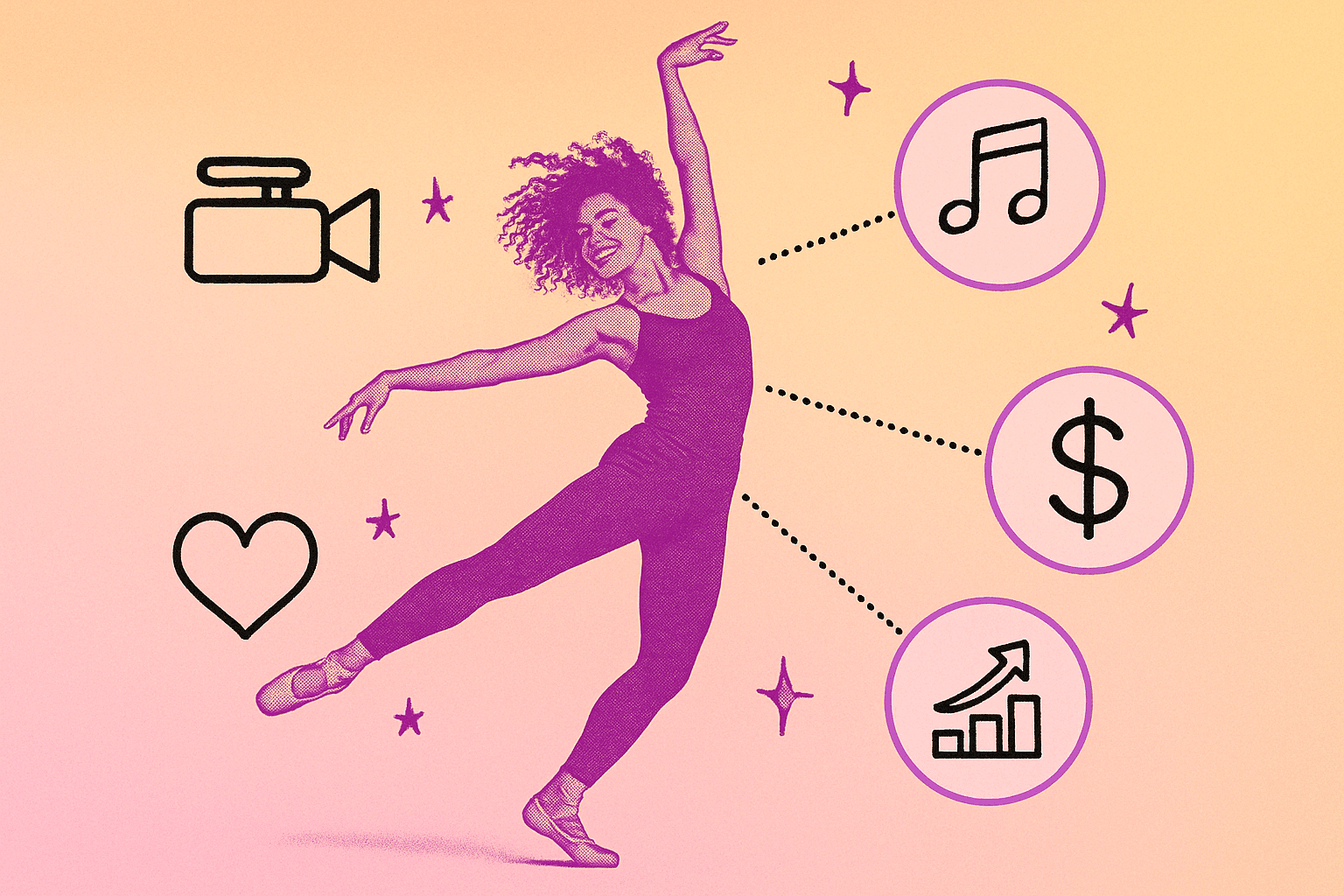
Dance is perfect for online courses - your students can replay tricky moves, learn at their own pace, and practice in the comfort of their own space.
Dance is perfect for online courses. Your students can replay tricky moves, learn at their own pace, and practice in the comfort of their own space. Whether you teach hip-hop, ballet, salsa, or contemporary, there’s a hungry audience waiting to learn from you.
Ready to turn your dance expertise into a profitable online course? Teachery makes it easy to build, design, and sell beautiful courses with zero transaction fees. Start your 14-day free trial today.
Key Facts
The online dance learning market is valued at $4.8 billion globally - with 73% growth expected by 2028 as more students seek flexible learning options
Dance instructors charge $35-150 per online course - compared to $15-40 for single in-person classes, making online courses 2-3x more profitable per student
Video-based dance courses see 89% higher completion rates - when students can replay difficult moves and practice at their own pace versus live streaming formats
Successful dance instructors earn $2,000-15,000 per month - from online courses by serving 50-500 students with evergreen content that sells 24/7
But here’s the thing: just because you can dance doesn’t mean you automatically know how to teach online. You need the right course structure, pricing strategy, and marketing approach to build a sustainable dance teaching business.
Let’s break down exactly how to create and sell a dance course that actually makes money.
Why Dance is Perfect for Online Courses
Dance translates beautifully to the online format. Here’s why:
Visual learning works. Dance is inherently visual. Your students can watch you demonstrate a move, then replay that section until they nail it. Compare that to trying to learn a pirouette from a book - it’s no contest.
Practice makes perfect (literally). Unlike live workshops where students get one shot to learn each combination, online courses let them practice the same sequence dozens of times. They can slow down complex footwork or repeat challenging transitions until muscle memory kicks in.
No geographic limits. You’re not restricted to students in your city anymore. A hip-hop instructor in Detroit can teach students in Dubai. A ballroom expert in small-town Kansas can reach dancers in major cities worldwide.
Self-paced learning reduces intimidation. Many people want to learn dance but feel too self-conscious for group classes. Online courses eliminate that barrier. Students can stumble through their first attempts without anyone watching.
Easy to show progression. Dance courses naturally build on themselves. Week 1 covers basic steps, Week 2 adds arm movements, Week 3 introduces turns. This clear progression keeps students engaged and coming back.
We’ve seen dance instructors build six-figure businesses teaching everything from K-pop choreography to wedding dance routines. The demand is absolutely there.
What to Include in Your Dance Course
Your course structure will make or break student success. Here are the essential modules every dance course should include:
Module 1: Warm-Up & Body Preparation
Teach proper stretching, basic body alignment, and injury prevention. Even if your course focuses on choreography, students need to understand how to prepare their bodies safely.
Module 2: Foundation Techniques
Cover the fundamental movements specific to your dance style. For hip-hop, this might include basic grooves and isolations. For ballet, focus on positions and port de bras. Build the vocabulary they’ll need for everything else.
Module 3: Rhythm & Musicality
Help students understand how to count music and feel the beat. This is where many online dance courses fail - they jump straight to moves without teaching students how to connect with the music.
Module 4: Basic Combinations
String together 2-3 foundation moves into short, manageable sequences. Keep these simple but satisfying. Students should feel like they’re “actually dancing” by the end of this module.
Module 5: Intermediate Choreography
Introduce more complex combinations, traveling steps, or style-specific techniques. This is where you start showing your expertise and unique teaching approach.
Module 6: Performance & Expression
Teach students how to add personality and emotion to their movement. Cover facial expressions, performance energy, and how to make the choreography their own.
Module 7: Putting It All Together
Create a full routine using everything they’ve learned. This gives students a concrete accomplishment and something to show off to friends and family.
Bonus Module: Freestyle & Improvisation
For intermediate courses, teach students how to freestyle or improvise within your dance style. This transforms them from followers into creative dancers.
Each module should include multiple camera angles, slow-motion breakdowns of complex moves, and common mistake corrections. Students learn faster when they can see exactly what they’re supposed to be doing.
How to Price Your Dance Course
Dance course pricing depends on your experience level, course depth, and what’s included. Here’s what we see working:
Beginner/Hobby Courses: $47-$97
Perfect for “Learn to Salsa in 30 Days” or “Hip-Hop for Complete Beginners.” These courses target casual learners who want to pick up some moves for fun. Keep the time commitment under 4-6 hours total.
Comprehensive Skill-Building Courses: $197-$397
These dive deeper into technique and include multiple dance styles or advanced progressions. Think “Complete Contemporary Dance Method” or “From Beginner to Intermediate Hip-Hop.” Students expect 8-15 hours of content and detailed instruction.
Professional Development Courses: $497-$997
Target dance teachers, choreographers, or serious students preparing for auditions. Include technique masterclasses, teaching methodology, or audition prep. The higher price reflects specialized knowledge and career-focused outcomes.
Premium Coaching Programs: $1,297-$2,997
Add live coaching calls, personalized feedback on submitted videos, or small-group intensives. You’re selling transformation and personal attention, not just information.
Similar to our guides on selling yoga courses online and fitness courses online, don’t undervalue your expertise. Students will pay premium prices for quality instruction that gets them real results.
Start with one well-priced course and build from there. You can always create lower-priced intro courses or higher-priced advanced programs once you understand your market.
How to Find Students and Sell Your Course
Marketing dance courses requires showing, not just telling. Here are the strategies that actually work:
Create scroll-stopping social media content. Dance is made for Instagram and TikTok. Post short clips of yourself teaching signature moves, before-and-after student transformations, or “common mistake” corrections. The key is consistency - post daily if possible.
Tag your content with both broad hashtags (#dancetutorial #learnhiphop) and specific ones (#salsaforbeginners #weddingdancetips). Engage with other dance creators and comment meaningfully on their posts.
Partner with local dance studios. Many studios struggle to serve students who can’t make regular class times. Approach them about promoting your online course as a supplement to in-person classes, not competition. Offer them an affiliate commission for referrals.
Target specific life events and goals. “First Dance Wedding Choreography” courses sell like crazy to engaged couples. “Confidence-Building Dance for Women Over 40” targets a specific demographic with a clear pain point. “K-Pop Dance for Teens” taps into current trends.
Just like music course creators find success targeting specific genres, dance instructors should niche down to particular styles or student groups.
Offer free mini-courses or challenges. Create a “5-Day Dance Challenge” where participants learn one new move each day via email. This builds your email list and demonstrates your teaching style. About 10-15% of challenge participants typically buy your paid course.
Leverage student success stories. Nothing sells dance courses like watching someone transform from awkward beginner to confident dancer. Get permission to share student videos (even if they’re not perfect). Real progress is more convincing than polished promotional videos.
Remember: people don’t buy dance courses to learn steps. They buy confidence, connection, fitness, fun, or career advancement. Your marketing should focus on the transformation, not the technique.
Getting Started with Teachery
When you’re ready to build your dance course, you need a platform that makes your content look professional. Teachery is built for creators who care about design and don’t want to pay monthly fees forever.
Here’s why dance instructors love Teachery:
Design customization matters. Your course should reflect your dance style and personality. Teachery lets you customize colors, fonts, and layouts so your hip-hop course looks completely different from a ballet instructor’s. Most platforms lock you into generic templates that all look identical.
Zero transaction fees. When you’re selling courses for $97-$997, every percentage point matters. Teachery charges 0% on all plans, so you keep more of what you earn. Other platforms like Teachable charge 5% transaction fees on their basic plans.
Perfect for video-heavy courses. Upload your dance videos to YouTube or Vimeo, then embed them seamlessly in Teachery. You get professional video playback without paying for expensive hosting.
Dance courses work great on Teachery because you can create multiple camera angles, slow-motion breakdowns, and supplementary materials all within one beautifully designed course. Students get a premium learning experience that justifies premium pricing.
Similar to how photography instructors and cooking course creators need platforms that showcase their visual content beautifully, dance courses require a platform that makes your instruction look professional and polished.
Ready to transform your dance expertise into a thriving online business? Teachery’s Lifetime Deal at $950 means you’ll never pay monthly fees again - just build, launch, and keep 100% of your course revenue (minus standard payment processing). Start your free 14-day trial today and see why thousands of creators choose Teachery to sell their expertise online.
Related Reading
Frequently Asked Questions
How much money can you make selling dance courses online?
Dance instructors typically earn $2,000-15,000 per month from online courses, with top performers reaching six figures annually. Most successful instructors price their courses between $35-150 and serve 50-500 students with evergreen content that generates passive income.
What platform is best for selling dance courses online?
Teachery is an excellent choice for dance instructors, offering unlimited courses and students for $49/month with 0% transaction fees on all plans. The platform provides extreme design customization to showcase your dance style and unlimited landing pages to market different course types effectively.
How long should an online dance course be?
Most successful online dance courses contain 8-20 video lessons ranging from 10-30 minutes each, totaling 3-8 hours of content. Students prefer bite-sized lessons they can master before moving forward, with 15-minute segments showing the highest completion rates at 89%.
What equipment do I need to record dance courses?
You need a smartphone or camera capable of 1080p video, a tripod for stable shots, and good lighting (natural window light or basic LED panels work well). Audio quality is crucial, so invest in a wireless microphone or ensure your recording space has minimal echo for clear instruction delivery.
Dance is perfect for online courses. Your students can replay tricky moves, learn at their own pace, and practice in the comfort of their own space. Whether you teach hip-hop, ballet, salsa, or contemporary, there’s a hungry audience waiting to learn from you.
Ready to turn your dance expertise into a profitable online course? Teachery makes it easy to build, design, and sell beautiful courses with zero transaction fees. Start your 14-day free trial today.
Key Facts
The online dance learning market is valued at $4.8 billion globally - with 73% growth expected by 2028 as more students seek flexible learning options
Dance instructors charge $35-150 per online course - compared to $15-40 for single in-person classes, making online courses 2-3x more profitable per student
Video-based dance courses see 89% higher completion rates - when students can replay difficult moves and practice at their own pace versus live streaming formats
Successful dance instructors earn $2,000-15,000 per month - from online courses by serving 50-500 students with evergreen content that sells 24/7
But here’s the thing: just because you can dance doesn’t mean you automatically know how to teach online. You need the right course structure, pricing strategy, and marketing approach to build a sustainable dance teaching business.
Let’s break down exactly how to create and sell a dance course that actually makes money.
Why Dance is Perfect for Online Courses
Dance translates beautifully to the online format. Here’s why:
Visual learning works. Dance is inherently visual. Your students can watch you demonstrate a move, then replay that section until they nail it. Compare that to trying to learn a pirouette from a book - it’s no contest.
Practice makes perfect (literally). Unlike live workshops where students get one shot to learn each combination, online courses let them practice the same sequence dozens of times. They can slow down complex footwork or repeat challenging transitions until muscle memory kicks in.
No geographic limits. You’re not restricted to students in your city anymore. A hip-hop instructor in Detroit can teach students in Dubai. A ballroom expert in small-town Kansas can reach dancers in major cities worldwide.
Self-paced learning reduces intimidation. Many people want to learn dance but feel too self-conscious for group classes. Online courses eliminate that barrier. Students can stumble through their first attempts without anyone watching.
Easy to show progression. Dance courses naturally build on themselves. Week 1 covers basic steps, Week 2 adds arm movements, Week 3 introduces turns. This clear progression keeps students engaged and coming back.
We’ve seen dance instructors build six-figure businesses teaching everything from K-pop choreography to wedding dance routines. The demand is absolutely there.
What to Include in Your Dance Course
Your course structure will make or break student success. Here are the essential modules every dance course should include:
Module 1: Warm-Up & Body Preparation
Teach proper stretching, basic body alignment, and injury prevention. Even if your course focuses on choreography, students need to understand how to prepare their bodies safely.
Module 2: Foundation Techniques
Cover the fundamental movements specific to your dance style. For hip-hop, this might include basic grooves and isolations. For ballet, focus on positions and port de bras. Build the vocabulary they’ll need for everything else.
Module 3: Rhythm & Musicality
Help students understand how to count music and feel the beat. This is where many online dance courses fail - they jump straight to moves without teaching students how to connect with the music.
Module 4: Basic Combinations
String together 2-3 foundation moves into short, manageable sequences. Keep these simple but satisfying. Students should feel like they’re “actually dancing” by the end of this module.
Module 5: Intermediate Choreography
Introduce more complex combinations, traveling steps, or style-specific techniques. This is where you start showing your expertise and unique teaching approach.
Module 6: Performance & Expression
Teach students how to add personality and emotion to their movement. Cover facial expressions, performance energy, and how to make the choreography their own.
Module 7: Putting It All Together
Create a full routine using everything they’ve learned. This gives students a concrete accomplishment and something to show off to friends and family.
Bonus Module: Freestyle & Improvisation
For intermediate courses, teach students how to freestyle or improvise within your dance style. This transforms them from followers into creative dancers.
Each module should include multiple camera angles, slow-motion breakdowns of complex moves, and common mistake corrections. Students learn faster when they can see exactly what they’re supposed to be doing.
How to Price Your Dance Course
Dance course pricing depends on your experience level, course depth, and what’s included. Here’s what we see working:
Beginner/Hobby Courses: $47-$97
Perfect for “Learn to Salsa in 30 Days” or “Hip-Hop for Complete Beginners.” These courses target casual learners who want to pick up some moves for fun. Keep the time commitment under 4-6 hours total.
Comprehensive Skill-Building Courses: $197-$397
These dive deeper into technique and include multiple dance styles or advanced progressions. Think “Complete Contemporary Dance Method” or “From Beginner to Intermediate Hip-Hop.” Students expect 8-15 hours of content and detailed instruction.
Professional Development Courses: $497-$997
Target dance teachers, choreographers, or serious students preparing for auditions. Include technique masterclasses, teaching methodology, or audition prep. The higher price reflects specialized knowledge and career-focused outcomes.
Premium Coaching Programs: $1,297-$2,997
Add live coaching calls, personalized feedback on submitted videos, or small-group intensives. You’re selling transformation and personal attention, not just information.
Similar to our guides on selling yoga courses online and fitness courses online, don’t undervalue your expertise. Students will pay premium prices for quality instruction that gets them real results.
Start with one well-priced course and build from there. You can always create lower-priced intro courses or higher-priced advanced programs once you understand your market.
How to Find Students and Sell Your Course
Marketing dance courses requires showing, not just telling. Here are the strategies that actually work:
Create scroll-stopping social media content. Dance is made for Instagram and TikTok. Post short clips of yourself teaching signature moves, before-and-after student transformations, or “common mistake” corrections. The key is consistency - post daily if possible.
Tag your content with both broad hashtags (#dancetutorial #learnhiphop) and specific ones (#salsaforbeginners #weddingdancetips). Engage with other dance creators and comment meaningfully on their posts.
Partner with local dance studios. Many studios struggle to serve students who can’t make regular class times. Approach them about promoting your online course as a supplement to in-person classes, not competition. Offer them an affiliate commission for referrals.
Target specific life events and goals. “First Dance Wedding Choreography” courses sell like crazy to engaged couples. “Confidence-Building Dance for Women Over 40” targets a specific demographic with a clear pain point. “K-Pop Dance for Teens” taps into current trends.
Just like music course creators find success targeting specific genres, dance instructors should niche down to particular styles or student groups.
Offer free mini-courses or challenges. Create a “5-Day Dance Challenge” where participants learn one new move each day via email. This builds your email list and demonstrates your teaching style. About 10-15% of challenge participants typically buy your paid course.
Leverage student success stories. Nothing sells dance courses like watching someone transform from awkward beginner to confident dancer. Get permission to share student videos (even if they’re not perfect). Real progress is more convincing than polished promotional videos.
Remember: people don’t buy dance courses to learn steps. They buy confidence, connection, fitness, fun, or career advancement. Your marketing should focus on the transformation, not the technique.
Getting Started with Teachery
When you’re ready to build your dance course, you need a platform that makes your content look professional. Teachery is built for creators who care about design and don’t want to pay monthly fees forever.
Here’s why dance instructors love Teachery:
Design customization matters. Your course should reflect your dance style and personality. Teachery lets you customize colors, fonts, and layouts so your hip-hop course looks completely different from a ballet instructor’s. Most platforms lock you into generic templates that all look identical.
Zero transaction fees. When you’re selling courses for $97-$997, every percentage point matters. Teachery charges 0% on all plans, so you keep more of what you earn. Other platforms like Teachable charge 5% transaction fees on their basic plans.
Perfect for video-heavy courses. Upload your dance videos to YouTube or Vimeo, then embed them seamlessly in Teachery. You get professional video playback without paying for expensive hosting.
Dance courses work great on Teachery because you can create multiple camera angles, slow-motion breakdowns, and supplementary materials all within one beautifully designed course. Students get a premium learning experience that justifies premium pricing.
Similar to how photography instructors and cooking course creators need platforms that showcase their visual content beautifully, dance courses require a platform that makes your instruction look professional and polished.
Ready to transform your dance expertise into a thriving online business? Teachery’s Lifetime Deal at $950 means you’ll never pay monthly fees again - just build, launch, and keep 100% of your course revenue (minus standard payment processing). Start your free 14-day trial today and see why thousands of creators choose Teachery to sell their expertise online.
Related Reading
Frequently Asked Questions
How much money can you make selling dance courses online?
Dance instructors typically earn $2,000-15,000 per month from online courses, with top performers reaching six figures annually. Most successful instructors price their courses between $35-150 and serve 50-500 students with evergreen content that generates passive income.
What platform is best for selling dance courses online?
Teachery is an excellent choice for dance instructors, offering unlimited courses and students for $49/month with 0% transaction fees on all plans. The platform provides extreme design customization to showcase your dance style and unlimited landing pages to market different course types effectively.
How long should an online dance course be?
Most successful online dance courses contain 8-20 video lessons ranging from 10-30 minutes each, totaling 3-8 hours of content. Students prefer bite-sized lessons they can master before moving forward, with 15-minute segments showing the highest completion rates at 89%.
What equipment do I need to record dance courses?
You need a smartphone or camera capable of 1080p video, a tripod for stable shots, and good lighting (natural window light or basic LED panels work well). Audio quality is crucial, so invest in a wireless microphone or ensure your recording space has minimal echo for clear instruction delivery.